Building a
Multi-Tenant AI
Voice SaaS
from Zero
Client
MiaoJie AI
Market
US Restaurants
Scope
Full-Stack SaaS
Status
Live & Scaled
01 / Problem
One AI agent
wasn't enough.
The client didn't need a single voice assistant bolted onto one location. They needed a platform — a SaaS infrastructure capable of onboarding dozens of independent US restaurant operators, each with their own menu, staff policies, and customer base, under a single unified system that could be managed and scaled from day one.
The core challenge: build from the ground up a multi-tenant AI platform where every component — from voice phone provisioning to order printing at the kitchen — had to work seamlessly across hundreds of physically separate locations without manual configuration per restaurant.
AI Voice at Scale
Every restaurant needed its own AI phone number, instantly provisioned and linked to that location's knowledge base — without dev intervention per client.
Multi-Tenant Architecture
A single backend needed to serve hundreds of separate restaurant accounts with isolated data, settings, and AI behaviour per tenant.
Physical Kitchen Integration
Orders taken by AI over the phone had to reach the actual kitchen printer at the correct physical location in real time — no manual relay.
End-to-End Order + Payment Flow
The system had to handle the full customer lifecycle: AI takes the order, Stripe sends a payment link, kitchen receives the print, and the owner is notified — all automated.
02 / Solution
A full SaaS platform,
built end-to-end.
SMAF AI designed and delivered the complete MiaoJie AI platform — a production-grade, multi-tenant SaaS application. Restaurant owners sign up, configure their AI agent via a clean dashboard, and go live with a fully functional AI phone receptionist and automated order pipeline. Any configuration change takes effect immediately without downtime or re-deployment.
Layer
Frontend
Layer
Backend API
Layer
Voice AI
Layer
Payments
Layer
Print & Ops
Layer
Database
03 / Features
What was built.
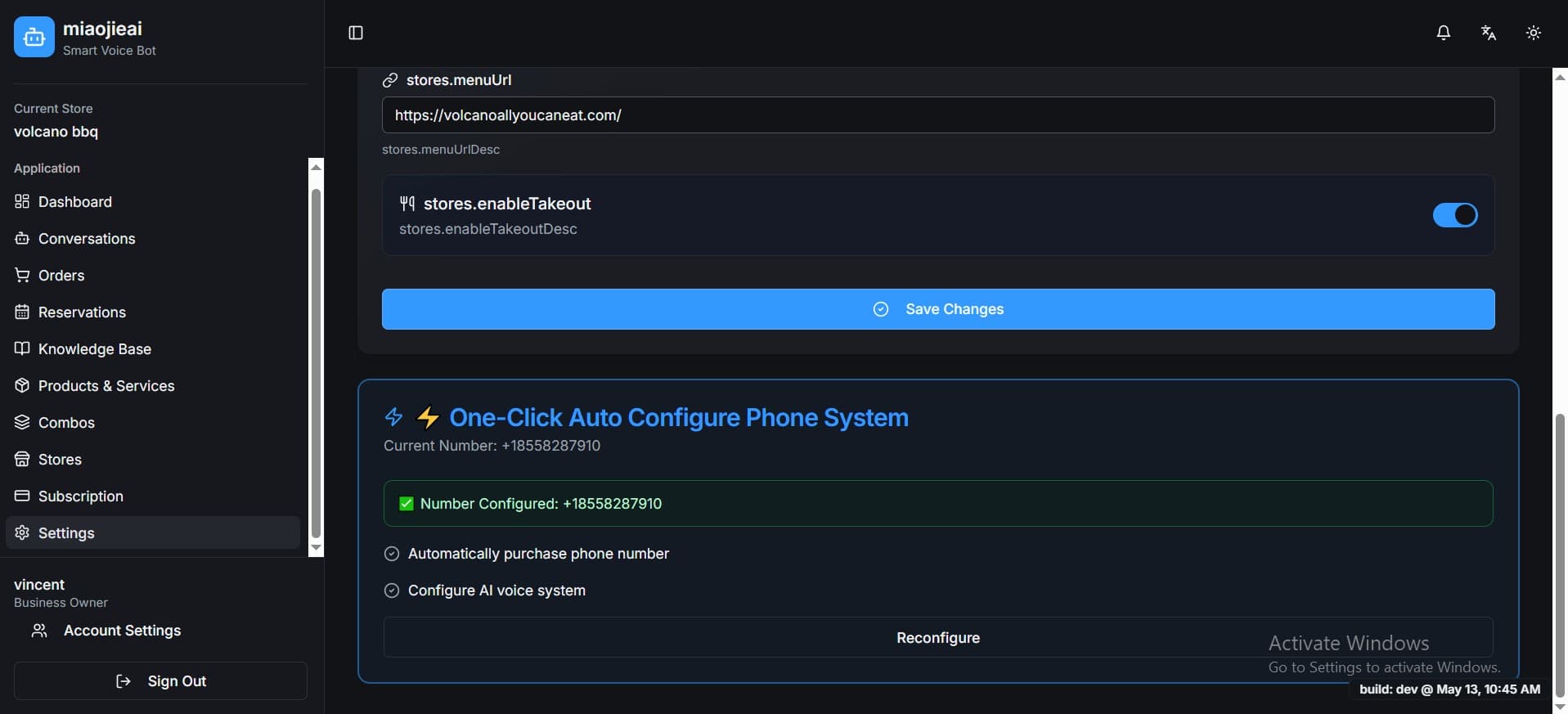
One-Click AI Phone Provisioning
Restaurant owners configure their AI voice agent and purchase a real US phone number with a single button click. Using Twilio's SIP trunking API, the number is provisioned in real time and tied directly to that restaurant's store ID and knowledge base in PostgreSQL — no engineering required.
Dynamic AI Agent Configuration
Owners upload their full menu via CSV export, add custom restaurant policies, and manage their knowledge base from the dashboard. Any update — a menu change, a new policy, updated hours — is reflected in the AI agent's behaviour immediately upon saving. No redeployment, no developer involvement.
AI Voice Ordering via LiveKit
Customers call the restaurant's number and are handled by a natural-language AI agent powered by LiveKit's real-time audio infrastructure. The agent knows the menu, restaurant hours, special policies, and can take a complete order end-to-end — 24/7, with zero hold time.
Automated Payment via Stripe + SMS
When an order is placed and online payment is selected, the system automatically generates a Stripe payment link and sends it to the customer's phone via Twilio SMS. The customer completes payment on a branded billing page. Cash and card-in-store modes are also supported, selectable per order.
Kitchen Printer Automation
Once an order is confirmed, PrintNode's webhook and API integration routes the formatted receipt to the correct kitchen printer at the corresponding restaurant. Printer health is monitored in real time — if a printer runs out of paper or ink, the owner and manager are alerted immediately via notification so service is never interrupted silently.
Real-Time Dashboard with WebSockets
The owner-facing dashboard receives live order updates via WebSocket connections — no page refresh required. A notification sound alerts the operator to new orders or system events the moment they arrive, keeping front-of-house staff informed without constant screen-checking.
“The real engineering challenge wasn't building an AI voice agent — that's relatively straightforward. The challenge was making every component composable, per-tenant, and zero-touch. A restaurant owner in Chicago and one in Los Angeles both get a fully isolated, fully configured AI system from a single platform.”
— SMAF AI Engineering Notes, MiaoJie AI Project
04 / Dashboard
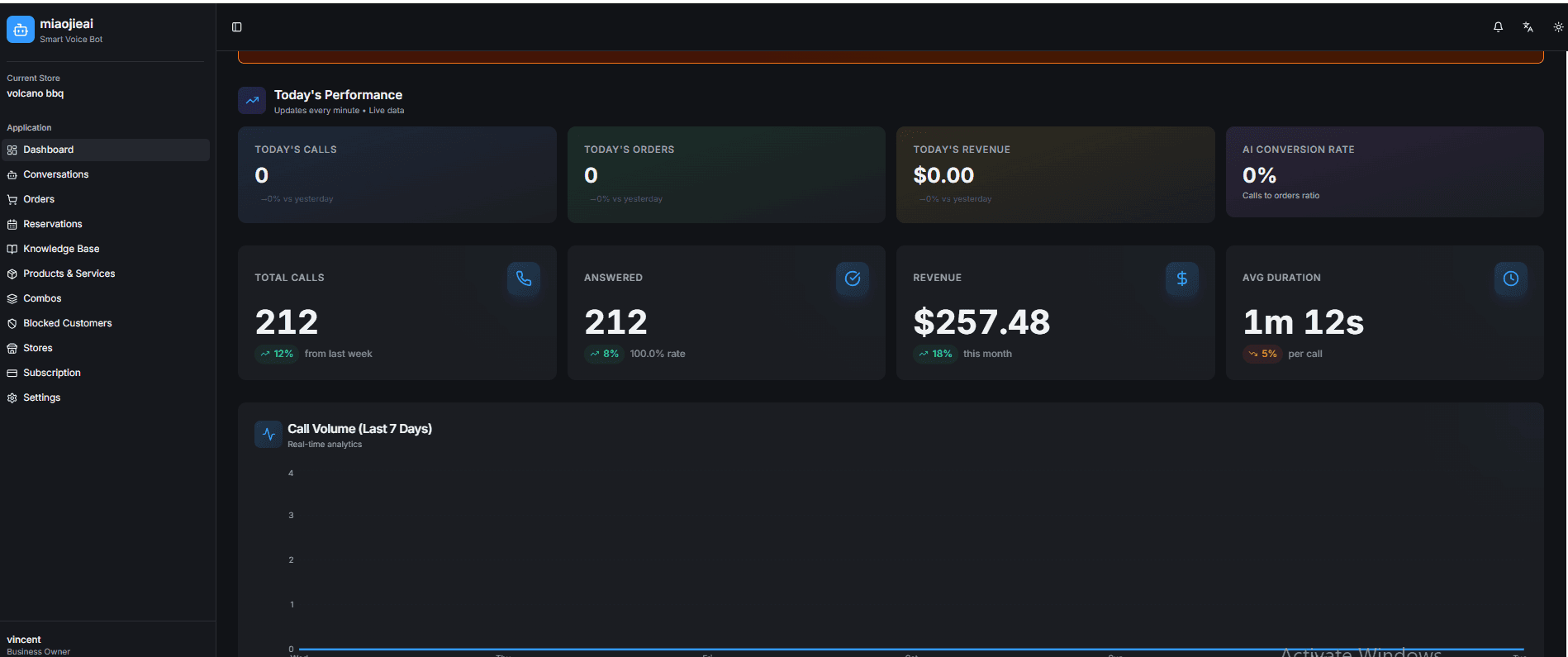
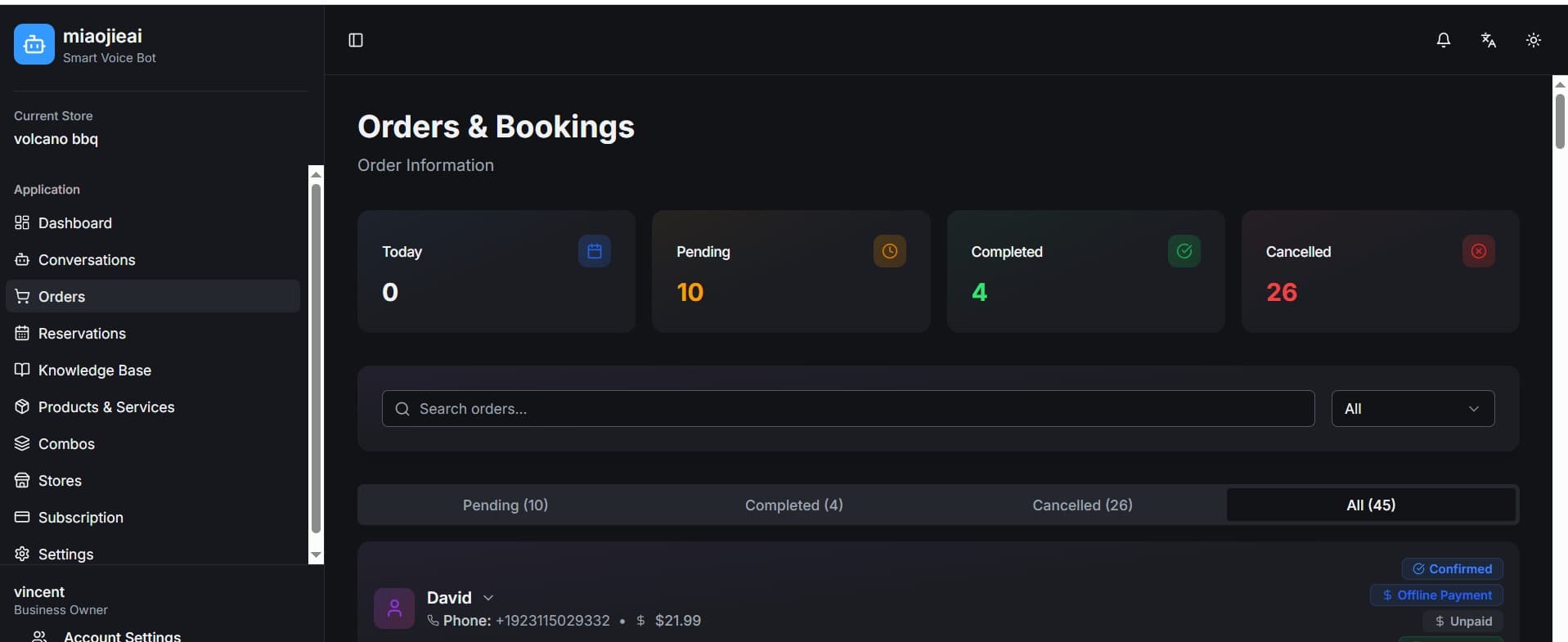
The product we built.
The MiaoJie AI dashboard was designed for restaurant operators, not developers. Clean, functional, and immediately actionable — owners could configure their entire AI system without a single support ticket.
05 / Industry Context
Why this matters now.
The restaurant industry is at an inflection point. Labor costs are up, customer expectations are higher than ever, and AI voice technology has quietly crossed the threshold from experiment to operational standard. MiaoJie AI was built into this moment — not chasing a trend, but meeting a structural shift.
34%
of US restaurants have adopted AI voice technology in 2025 — up from near zero in 2022. Mainstream adoption has arrived.
Source · Hostie AI / SoundHound, 2025
87%
reduction in missed calls reported by restaurants after implementing AI voice agents. Missed calls represent direct lost revenue.
Source · Kea AI / Hostie AI, Q2 2025
95%
order accuracy rate achieved by modern restaurant voice AI — 19 out of 20 guest interactions handled correctly without human escalation.
Source · Hostie AI Benchmark Report, 2025
35%
average reduction in operational costs for businesses that automate call handling via AI voice agents, by reducing front-of-house call burden.
Source · Thoughtly / McKinsey, 2025
89%
of Americans say they are open to interacting with an AI agent at a restaurant — consumer acceptance is no longer a barrier to adoption.
Source · Missed Connection / Forbes, 2024
$18K
per month, per location — the upper end of revenue increases reported by early restaurant AI adopters, driven by captured calls and upselling.
Source · Hostie AI Case Studies, 2025
The market opportunity
The global voice AI market is projected to expand by $10.96 billion between 2024 and 2029. High-demand restaurants already field between 800 and 1,000 calls per month — the vast majority of which contain no revenue, just basic questions that could be answered by an AI agent. A dedicated human phone host costs approximately $45,724 per year per location. The economics of switching are not marginal — they're structural.
06 / Outcomes
What was delivered.
100%
End-to-end automation from voice call to kitchen print — the entire order lifecycle runs without human relay, across every restaurant on the platform.
0-touch
Phone number provisioning. Restaurants go live with a real AI voice number via a single button — no engineering involvement required per tenant.
Live
AI agent updates. Any menu change, policy edit, or knowledge base update takes effect instantly — no redeployment, no lag.
∞
Concurrency. The SaaS model handles unlimited restaurant tenants simultaneously — each fully isolated, fully independent, on shared infrastructure.
24/7
AI availability. Calls answered at 3am, during lunch rush, and on holidays — the AI never goes offline, never gets overwhelmed.
The problem wasn't just getting AI to answer a phone. It was building an infrastructure where the AI was always the right AI for that restaurant — and where every restaurant could configure their own system independently, instantly, and without ever calling us.
— SMAF AI, Project Retrospective
Built by
SMAF AI
Smart Systems. Futuristic Solutions.